








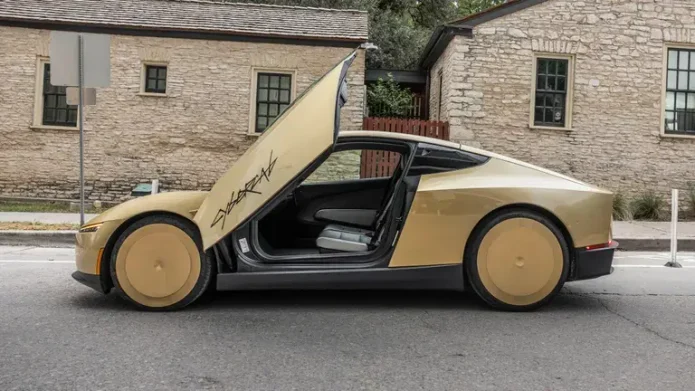

The Tesla Cybercab is a purpose-built autonomous electric robotaxi designed for driverless transportation. It features two seats, no steering wheel or pedals, a central touchscreen, app-based ride controls, and Tesla’s autonomous-driving technology. Its final consumer price and officially advertised EPA range remain key details to watch.
ManlyZine.com
The Tesla Cybercab is Tesla’s purpose-built two-seat autonomous electric vehicle designed primarily for robotaxi service. Unlike a conventional Tesla, it has no steering wheel or pedals, uses a fully autonomous driving system, and is operated as part of Tesla’s Robotaxi network. As of September 2026, Cybercab rides are available in limited areas of Austin, Texas, while Tesla’s broader Robotaxi service also operates with Model Y vehicles in several Texas and Florida cities. Tesla has also begun production of Cybercab, making the project more than a concept vehicle.
The most important point for prospective buyers and technology observers is that Cybercab is not currently a normal consumer vehicle with a published retail price and conventional owner configuration. Tesla says commercial or fleet purchasers can express interest, but an ordinary consumer purchase price has not been officially established. Tesla originally said in 2024 that Cybercab would be available for less than $30,000, but that figure should be treated as an announced target rather than a confirmed 2026 retail price.
Tesla Cybercab at a Glance
| Feature | Current information |
|---|---|
| Vehicle type | Autonomous electric robotaxi |
| Seating | Up to 2 passengers |
| Steering wheel | None |
| Pedals | None |
| Doors | Butterfly-style doors |
| Primary use | Tesla Robotaxi service |
| Current Cybercab service | Limited areas of Austin, Texas |
| Interior control | Central touchscreen + Robotaxi app |
| Trunk | 20.2 cubic feet |
| Legroom | 43.4 inches |
| Ground clearance | 5.8 inches |
| Official consumer price | Not currently published |
| Original Tesla price target | Under $30,000 |
| Official Tesla EPA range | Not prominently published by Tesla |
| Autonomous operation | Designed for driverless operation |
| Charging concept | Tesla originally described inductive charging |
Tesla’s current rider documentation confirms that the Cybercab can carry two passengers and provides 43.4 inches of legroom, 38.3 inches of headroom, 51.9 inches of shoulder room, and 20.2 cubic feet of rear trunk volume.
Table of Contents

What Is the Tesla Cybercab?
The Cybercab is fundamentally different from simply putting autonomous-driving software into an existing Tesla.
Tesla designed the vehicle specifically around the idea that there may be no human driver at all. That changes the physical architecture of the vehicle. There is no conventional driver position with a steering wheel and pedals, and the cabin is optimized for passengers rather than for someone controlling the car.
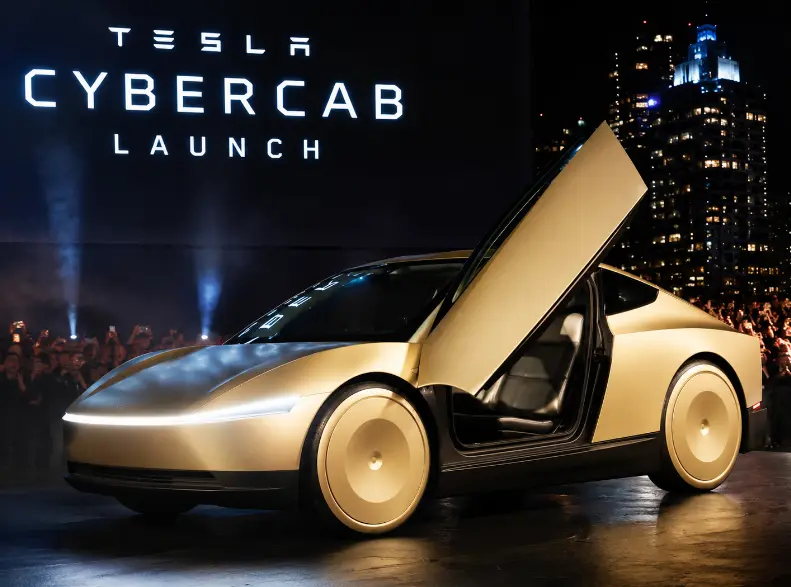
Tesla describes Cybercab as a golden two-seater with butterfly doors, a large interactive touchscreen, entertainment functions, connectivity features, and substantial luggage space. The company says the vehicle is designed to operate autonomously across city streets, highways, intersections, and parking areas.
This design makes Cybercab closer to a robotaxi platform than a traditional passenger car.
A conventional EV is purchased primarily for personal transportation. A robotaxi is potentially an asset that can be used repeatedly throughout the day, serving multiple passengers. That distinction is central to Tesla’s business strategy.
Tesla Cybercab Features
1. Two-Seat Autonomous Interior
Cybercab accommodates up to two passengers.
That may initially seem like a limitation compared with the five-seat Model 3 or Model Y, but the smaller capacity is deliberate. A two-person configuration can potentially reduce vehicle weight, interior complexity, and unused passenger space for individual ride-hailing trips.
Tesla says the Cybercab has bench-style seating designed with accessibility in mind. Its trunk provides 20.2 cubic feet of cargo capacity, which Tesla says is enough for typical passenger luggage.
For a real-world airport scenario, the configuration is particularly relevant: two passengers can travel with luggage without requiring a full-size SUV.
2. No Steering Wheel or Pedals
The most visually significant Cybercab feature is also its biggest engineering and regulatory distinction.
There is no steering wheel and no accelerator or brake pedal.
This means the passenger cannot simply take control if the autonomous system encounters an unexpected situation. The vehicle must therefore be designed, validated, and operated as a genuinely driverless system rather than as a driver-assistance vehicle.
That distinction is important because Tesla’s consumer-facing Full Self-Driving (Supervised) system is not equivalent to an unsupervised robotaxi. Tesla’s regular FSD product requires a human driver to supervise the system, whereas Cybercab is designed for autonomous Robotaxi operation.
3. Central Touchscreen
Instead of a traditional driver-oriented dashboard, Cybercab uses a central touchscreen as an important passenger interface.
Tesla’s rider documentation says passengers can interact with climate and entertainment functions through the touchscreen or Robotaxi app. Passenger preferences can also be saved and carried over between rides.
This reflects a fundamental shift in vehicle UX:
Traditional car: driver controls the vehicle → passengers are secondary.
Robotaxi: vehicle drives itself → passengers interact with a transportation service.
4. Robotaxi App Integration
The Cybercab experience begins before the passenger enters the vehicle.
Tesla’s current rider guide describes the process as:
- Open the Robotaxi app.
- Enter a destination within the service area.
- Review the estimated fare and wait time.
- Confirm the trip.
- Match the arriving vehicle’s license plate with the app.
- Enter the Cybercab.
- Fasten the seat belt.
- Tap Start Ride.
Passengers can also change their destination during the journey through the app.
This is an important practical difference from conventional taxi services: the app, vehicle, payment process, passenger identity, and autonomous-driving system are integrated into one ecosystem.
Tesla Cybercab Price: How Much Will It Cost?
The Cybercab’s price is one of the most searched questions, but it requires careful distinction between Tesla’s original target and a confirmed retail price.
At the October 2024 Cybercab unveiling, Elon Musk said the vehicle would be available for less than $30,000. Tesla also discussed an operating cost of roughly $0.20 per mile over time.
However, that does not mean that $29,999 is the confirmed 2026 purchase price.
As of September 2026, Tesla’s Cybercab FAQ does not list a conventional consumer MSRP. Instead, Tesla says people interested in purchasing an individual or fleet Cybercab for commercial purposes can submit an inquiry.
So, what is the Cybercab price?
Current confirmed consumer MSRP: Not published.
Original Tesla target: Under $30,000.
This distinction matters for anyone researching Cybercab as a potential personal vehicle or investment. A launch target is not the same thing as a final transaction price, particularly when the vehicle’s regulatory status, production scale, software capabilities, and commercial operating model are still evolving.
Tesla Cybercab Range: How Far Can It Drive?
Range is another area where online Cybercab specifications need careful interpretation.
Tesla’s current public Cybercab rider documentation provides detailed cabin and cargo dimensions, but it does not prominently publish a consumer-facing official EPA range figure in the same way that Tesla publishes specifications for its mainstream vehicles.
Some 2026 reporting based on regulatory documentation has indicated a relatively small battery and an estimated range approaching 280 miles under EPA testing, but these figures should be distinguished from specifications directly published by Tesla for consumers.
For a robotaxi, however, maximum range is only one part of the equation.
A commercial autonomous vehicle may return to a charging facility repeatedly throughout the day. What matters operationally is not simply:
“How many miles can it travel on one charge?”
but rather:
- How many passenger miles can it complete per day?
- How quickly can it recharge?
- How much energy does each passenger mile consume?
- How often does it need maintenance?
- How efficiently can Tesla reposition and recharge the fleet?
- How much downtime occurs between rides?
This is why Cybercab should be evaluated as a fleet vehicle, not merely as another EV.
How Does Tesla Cybercab Autonomous Driving Work?
Cybercab is designed around Tesla’s vision-based autonomous-driving approach.
Tesla says Cybercab uses camera vision and sensors to navigate roads and does not require a steering wheel because the vehicle is intended to operate fully autonomously.
The basic autonomous-driving pipeline can be understood in several stages.
Stage 1: Perception
The vehicle collects information about its environment using onboard sensors, particularly cameras.
The system needs to recognize:
- Other vehicles
- Pedestrians
- Cyclists
- Traffic lights
- Road markings
- Intersections
- Obstacles
- Parking areas
- Road geometry
Stage 2: Prediction
Recognizing an object is not enough.
An autonomous vehicle must estimate what nearby road users are likely to do next.
For example, a pedestrian standing near a crosswalk might remain on the sidewalk—or suddenly step into the road.
A vehicle approaching an intersection might continue straight, turn, or stop.
Autonomous driving therefore requires continuous prediction under uncertainty.
Stage 3: Planning
The system then determines an appropriate driving strategy.
It must select:
- Lane position
- Speed
- Following distance
- Turning path
- Stopping point
- Route
- Response to unexpected road users
Stage 4: Vehicle Control
Finally, the autonomous system translates its plan into vehicle actions.
Because Cybercab has no pedals or steering wheel for a passenger to use, these decisions must be executed electronically by the vehicle itself.
This architecture is what makes Cybercab fundamentally different from a normal car equipped with advanced driver assistance.
Is Tesla Cybercab Truly Fully Autonomous?

Cybercab is designed and deployed as a driverless vehicle, but “fully autonomous” should not be interpreted as “capable of safely operating everywhere under every possible condition.”
Autonomous driving is highly dependent on operational conditions.
A robotaxi system may be restricted by:
- Geographic operating areas
- Weather
- Road infrastructure
- Construction
- Traffic complexity
- Regulatory approval
- Software capabilities
- Fleet-support procedures
Tesla’s current Cybercab deployment illustrates this point. Cybercab rides are currently available only in limited areas of Austin, even though Tesla’s wider Robotaxi service has expanded to additional Texas and Florida locations using Model Y vehicles.
The difference between a controlled operating domain and universal autonomy is crucial.
A vehicle can be capable of autonomous operation in a defined environment without being capable of safely operating anywhere in the world.
Tesla Cybercab vs. Tesla Model Y Robotaxi
Tesla is currently using both Cybercab and Model Y vehicles within its Robotaxi strategy.
The distinction is straightforward:
| Category | Cybercab | Model Y Robotaxi |
|---|---|---|
| Purpose-built robotaxi | Yes | No |
| Steering wheel | No | Vehicle-dependent |
| Pedals | No | Vehicle-dependent |
| Passenger capacity | Up to 2 | Up to 4 |
| Vehicle design | Dedicated autonomous platform | Modified existing Tesla platform |
| Current service | Limited Austin areas | Multiple Texas and Florida locations |
| Cargo | 20.2 cu. ft. rear trunk | Larger overall utility |
Tesla says Cybercab is designed specifically for full autonomy, while Model Y vehicles are also being used in the Robotaxi network.
This two-platform strategy is strategically important.
Model Y allows Tesla to deploy robotaxi services using an existing high-volume vehicle platform. Cybercab, by contrast, is designed from the beginning around autonomous operation.
Cybercab Safety and the 2026 Regulatory Question
One of the most important Cybercab developments in 2026 is not a new feature—it is regulatory scrutiny.
On September 4, 2026, the U.S. National Highway Traffic Safety Administration (NHTSA) announced an Audit Query investigating Tesla’s self-certification that Cybercab complies with applicable Federal Motor Vehicle Safety Standards.
NHTSA specifically noted that the investigation will examine the technical data and processes Tesla used to certify a vehicle that lacks traditional human controls.
This is significant because traditional vehicle regulations were largely designed around human-operated vehicles.
Cybercab challenges assumptions involving components such as:
- Steering controls
- Brake pedals
- Mirrors
- Human-driver interaction
- Emergency control
NHTSA also emphasized that existing federal standards remain in force while regulatory changes are being developed.
Therefore, the future of Cybercab depends on more than engineering.
It also depends on regulatory approval, compliance interpretation, insurance frameworks, liability rules, and local operating permissions.
What Happens If Something Goes Wrong During a Cybercab Ride?
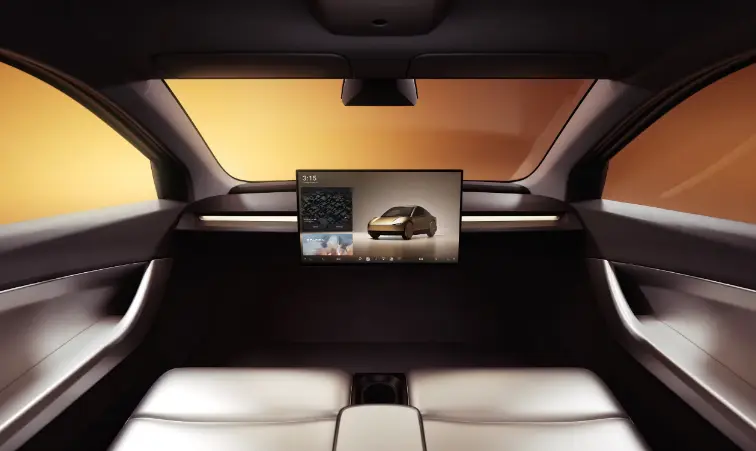
The absence of a steering wheel creates an important passenger-safety question: what does the passenger do if something unexpected happens?
Tesla’s current rider system provides app-based support and vehicle interaction functions. The company also provides procedures for emergencies and rider support through its Robotaxi infrastructure.
Passengers are not expected to become backup drivers.
That is precisely why driverless vehicles require a different safety architecture. The responsibility moves from a human driver toward:
vehicle sensors → autonomous software → remote/service infrastructure → emergency procedures → regulatory oversight.
This also explains why autonomous vehicles require substantially more than an impressive demonstration drive.
The difficult engineering problem is not making a vehicle drive itself for a few minutes on a prepared route. The difficult problem is making the entire transportation system robust enough to handle thousands of unpredictable real-world situations repeatedly.
Who Is the Tesla Cybercab For?
Cybercab makes the most sense in several practical scenarios.
Urban commuters
For short urban journeys, a driverless two-seat vehicle could provide direct transportation without requiring parking at the destination.
Airport passengers
Two passengers plus luggage are a natural use case because Tesla specifically designed Cybercab with substantial trunk capacity.
People who cannot or do not want to drive
A mature robotaxi network could expand transportation access for people who do not own a vehicle or cannot drive.
Tesla specifically describes accessibility features including wheelchair-height bench seating, space for assistive devices, service animals, and Braille controls.
Fleet operators
The strongest business case may ultimately be commercial rather than personal.
A Cybercab that operates repeatedly throughout the day could generate revenue while its owner is not physically present.
That is fundamentally different from the economics of a privately owned car, which typically sits unused for most of the day.
What Could Make Cybercab Successful?
Cybercab’s long-term success depends on several factors.
1. Reliable autonomy
The vehicle needs to handle ordinary driving situations consistently while also managing rare edge cases.
2. Regulatory acceptance
The NHTSA investigation demonstrates that technical capability and legal deployment are separate issues.
3. Production scale
Tesla has stated that Cybercab is part of its next-generation production strategy and began production in 2026.
4. Operating economics
The robotaxi must achieve sufficiently low costs per passenger mile to compete with traditional ride-hailing and other autonomous fleets.
5. Passenger trust
Consumers must feel comfortable entering a vehicle without a human driver.
This may ultimately be just as important as raw technical performance.
Tesla Cybercab: Key Advantages and Challenges
Potential advantages
- Purpose-built for autonomous transportation
- No steering wheel or pedals
- Two-passenger configuration optimized for individual trips
- Large touchscreen and app integration
- Significant cargo space for a two-seat vehicle
- Potentially lower operating costs at fleet scale
- Designed for continuous commercial utilization
- Integration with Tesla’s Robotaxi ecosystem
Major challenges
- No confirmed consumer retail MSRP
- Limited Cybercab availability
- Regulatory scrutiny in the United States
- Autonomous-driving edge cases
- Need for reliable operation across changing environments
- Passenger acceptance of completely driverless transportation
- Production and fleet-scaling requirements
- Uncertainty around the final business model
FAQs
What is the Tesla Cybercab?
The Tesla Cybercab is a purpose-built autonomous electric robotaxi designed for driverless transportation. Unlike conventional Tesla vehicles, it has no steering wheel or pedals and is designed around a two-passenger cabin. Its features include a central touchscreen, app-based ride controls, luggage space, and integration with Tesla’s Robotaxi service.
How much will the Tesla Cybercab cost?
The Tesla Cybercab price has not been established as a confirmed consumer retail MSRP. Tesla previously announced a target of less than $30,000, but that figure should not be treated as a final 2026 retail price. Commercial availability and Tesla’s eventual pricing strategy remain important factors for potential buyers and fleet operators.
What is the Tesla Cybercab range?
The Tesla Cybercab range is an important consideration for autonomous fleet operations. Tesla has not prominently published a final consumer-facing EPA range specification in its current Cybercab information. Reported regulatory-document figures have suggested a range approaching 280 miles, but buyers should distinguish reported estimates from officially advertised Tesla specifications.
How does Tesla Cybercab autonomous driving work?
Tesla autonomous driving on Cybercab is designed to operate the vehicle without human steering or pedal input. The system uses onboard sensing, computer vision, artificial intelligence, navigation, prediction, planning, and vehicle control to interpret road conditions and perform driving tasks. This differs from Tesla’s consumer FSD (Supervised), which requires an attentive human driver.
Is the Tesla Cybercab available for Robotaxi service?
Yes. The Tesla Cybercab has entered limited real-world Robotaxi operation, although availability remains geographically restricted. Tesla’s Robotaxi strategy also uses Model Y vehicles in selected locations. Cybercab is specifically designed around driverless operation, making it different from conventional Tesla vehicles equipped with supervised driver-assistance technology.
The Bottom Line: Is Tesla Cybercab the Future of Transportation?
The Tesla Cybercab is significant because Tesla is no longer presenting autonomous driving simply as a software feature added to a conventional car. Cybercab represents a vehicle designed around the assumption that the human driver can be removed from the transportation equation.
As of September 2026, that vision has moved into limited real-world service. Tesla has begun Cybercab production, limited driverless Cybercab rides are operating in Austin, and the company is expanding its broader Robotaxi network. At the same time, federal regulators are examining Tesla’s certification approach, demonstrating that autonomous transportation remains as much a regulatory challenge as a technological one.
The biggest unanswered question is therefore not whether Cybercab can drive without a steering wheel.
It can.
The bigger question is whether Tesla can make that capability safe, reliable, affordable, legally deployable, and economically scalable across millions of real-world journeys.
For consumers researching the Cybercab in 2026, the most accurate conclusion is that it should be viewed as an early commercial autonomous vehicle platform rather than a conventional Tesla available for ordinary consumer purchase. Tesla’s earlier promise of a sub-$30,000 vehicle remains an important reference point, but there is still no confirmed consumer MSRP that should be treated as final.
If Tesla can solve the remaining challenges in autonomy, regulation, production, and fleet economics, Cybercab could become one of the company’s most consequential products. If those challenges prove harder than expected, its rollout could remain geographically limited for considerably longer.
Either way, Cybercab marks an important transition: the Tesla vehicle is increasingly being designed not simply as something a person drives, but as a software-controlled transportation service that drives itself.