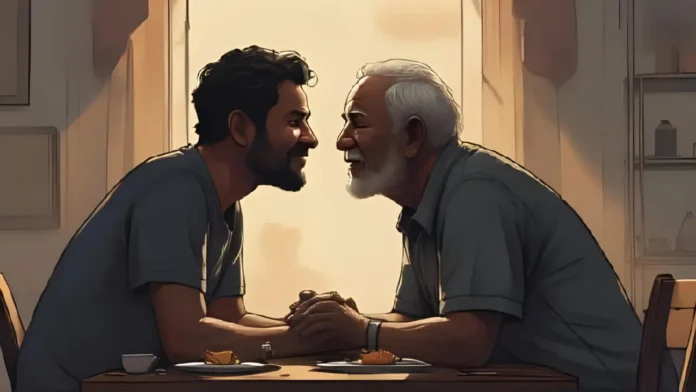
A story of reconciliation with my father explores how healing can begin even when the relationship remains incomplete. Through honest reflection, long-held silence, and late emotional breakthroughs, this journey shows that meaningful closure doesn’t require perfection—only understanding and a willingness to reconnect.
ManlyZine.com
Reconciliation with my father wasn’t a single moment of forgiveness but a gradual journey of understanding, vulnerability, and emotional truth. This story explores how years of distance, unspoken feelings, and generational silence can slowly transform into healing— even if the ending remains unfinished. It’s a reminder that imperfect closure can still change a life.
Every family carries emotional distances that stretch across years. Some are small gaps, easy to cross with a simple conversation. Others widen over time, becoming silent walls built from unspoken expectations, misunderstandings, and wounds we learned to ignore.
This is a story many adults quietly carry: the complicated relationship with a father. A relationship filled with pride, fear, longing, and the constant question — Will we ever truly understand each other?
“A story of reconciliation with my father — or one left unfinished” captures that universal struggle. It’s a journey toward healing, even if the ending remains uncertain. And sometimes, an unfinished reconciliation is still powerful enough to change a life.
Table of Contents

Why Reconciliation with a Father Matters
The father–child bond shapes identity, confidence, emotional security, and how we form relationships as adults. A father’s silence can feel like rejection. His distance can become our blueprint for how we treat ourselves.
But the opposite is also true:
A single moment of vulnerability or apology from him can soften years of hardened memory. A small gesture of care can become a bridge across a lifetime.
Reconciliation with a father doesn’t have to mean perfection or full closure. It can simply mean understanding who he was, what he struggled with, and how his own fears or limitations shaped the way he expressed — or failed to express — love.
And even an incomplete reconciliation can be enough to break old cycles and create a healthier emotional path forward.
Why Healing Is So Difficult
Reconnecting with a father is one of the hardest emotional tasks for many adults. Several obstacles often stand in the way:
1. Generational Silence
Many fathers grew up in eras where expressing emotion was a weakness. Apologies were never modeled. Vulnerability wasn’t allowed.
So they learned to love through actions, not words — work, sacrifice, discipline — even if that love was never spoken.
2. Accumulated Resentment
Hurt tends to pile up. Missed birthdays. Withheld praise. A harsh comment at the wrong moment. A lack of presence when it was needed most.
These small injuries become heavy emotional baggage.
3. Fear of Rejection
Children — even as adults — often fear hearing what they already suspect:
“That’s just how I am,”
“I did nothing wrong,”
or the hardest…
“I can’t change.”
4. Emotional Scars
Some father–child relationships carry deeper wounds: abandonment, addiction, conflict, or unpredictable behavior.
Healing in these cases can be delicate, slow, and sometimes safer from a distance.
Yet even with all these challenges, the desire for peace remains.
Because reconciliation isn’t only about fixing the relationship — it’s about finding freedom from the past.
A Fictional Story: “The Last Walk With My Father”

To explore this theme, imagine this story.
I. Childhood Echoes
I grew up believing my father was made of stone. Strong, silent, immovable. He wasn’t cruel — just distant. He fed us, provided for us, kept the house running — but our conversations rarely went beyond basic instructions.
He never said “I’m proud of you.”
He never asked, “How are you?”
He never hugged me except on my first day of school.
I spent my youth adapting — becoming self-reliant on the outside, but hungry for acknowledgment on the inside. I chased achievements, hoping one day he’d soften, look at me, and say, “Well done.”
He never did.
II. Adulthood and Distance
When I moved out, I called him on holidays out of obligation. He answered with the same low, dry voice:
“Are you eating well?”
“Working hard?”
“Okay, stay healthy.”
Nothing more.
Sometimes I was angry at him. Sometimes I missed him. Sometimes I didn’t know which feeling belonged to me and which belonged to the child I used to be.
Life kept moving — jobs, relationships, long nights, new responsibilities. And like many adult children, I let time create distance, telling myself it was normal.
III. The Unexpected Call
One rainy afternoon, my mother called.
“Your father… he wants to see you.”
Her voice was soft. Nervous.
Something in me tightened.
I visited a few days later. The house felt strangely smaller. My father looked older, his shoulders narrower, his hands shaking slightly when he poured tea.
He didn’t waste time.
“I wasn’t a good father,” he said quietly.
The words stunned me.
He had never admitted weakness before. Never acknowledged the distance. Never reflected on the past.
I wanted to respond, but I couldn’t. My throat tightened. Every emotion I had bottled up for decades clenched at once.
He continued, looking down at his hands.
“I didn’t know how to talk to you. I didn’t know how to show things… feelings. My father never did. I thought being strict, being silent… was the way.”
He took a breath.
“I’m sorry.”
A single apology — late, imperfect, trembling — broke something open inside me.
IV. A Conversation Years in the Making
What followed wasn’t dramatic. We didn’t hug. We didn’t cry. We just talked — slowly, hesitantly — about old memories, about what he had meant to say but didn’t know how.
He told me he worried constantly, even when he seemed cold.
He told me he was proud, even if he never said it.
He told me he wanted to be better, but didn’t know how to start.
I told him I had been angry. Hurt. Confused.
I told him I struggled for years to understand him.
I told him I wanted peace, too.
It wasn’t closure.
It wasn’t complete forgiveness.
But it was a beginning — a small, fragile bridge.
V. The Unfinished Ending
A few months later, he passed away quietly.
The reconciliation we began never fully matured. There were still questions I wanted to ask, stories I wanted to hear, apologies I wanted to give, and moments I wanted us to share.
For a long time, this unfinished ending hurt more than the years of distance before it.
But then I realized:
Even incomplete healing is still healing.
His apology wasn’t everything I needed — but it was something.
Our conversation wasn’t long — but it was real.
Our story wasn’t finished — but it began, and that mattered.
In the end, reconciliation doesn’t have to be perfect to be meaningful.
Even an unfinished apology can soften anger, open understanding, and allow peace into a heart that carried weight for too long.
The Lessons of an Unfinished Reconciliation
From this story — fictional, but deeply human — come several universal truths:
1. Parents Are Human Before They Are Parents
They struggle. They fear. They repeat the patterns they grew up with.
Understanding this doesn’t excuse their mistakes, but it helps us release resentment.
2. Healing Often Starts With a Single, Honest Moment
Sometimes one vulnerable sentence — “I’m sorry,” “I was wrong,” or “I didn’t know how to love you” — is enough to create a turning point.
3. Closure Is Not Always a Complete Ending
Some reconciliations remain open-ended, half-formed, unexplored. And yet they still bring relief, clarity, and emotional growth.
4. You Can Continue the Healing Alone
Even if the father is gone, or unavailable, or unwilling to reconcile, you can still find peace through reflection, empathy, and letting go.
Final Reflection: Stories That Don’t End Still Matter
A reconciliation with a father is rarely a clean narrative. It’s messy, emotional, fragile, and unpredictable. Some stories end in forgiveness. Some remain unfinished. Some never begin at all.
But every attempt — every word spoken, every truth admitted, every moment of understanding — is part of healing.
The goal is not a perfect ending.
The goal is peace.
Even if the story remains unfinished.

FAQs
What does reconciliation with my father really mean?
Reconciliation with my father means rebuilding emotional trust, addressing unresolved father wounds, and finding healing in the relationship. Even if conversations remain incomplete, the process allows personal growth and renewed understanding.
Can a father–child relationship heal even after years of silence?
Yes. Healing a father relationship is possible even after long silence. Honest dialogue, emotional family stories, and small gestures of vulnerability often create breakthroughs that lead to meaningful but sometimes unfinished reconciliation.
How do I start reconciliation with my father if the relationship feels broken?
Begin with small steps: a message, a short visit, or sharing a memory. These ease tension, open space for emotional healing, and help address unresolved father wounds while allowing both sides to reconnect gently.
Is it normal for reconciliation with my father to remain unfinished?
Absolutely. Many emotional family stories end without full closure. Unfinished reconciliation can still provide comfort, reduce resentment, and allow personal healing—even without a perfect ending.
How does unresolved reconciliation with a father impact adulthood?
Unresolved father wounds can influence confidence, relationships, and emotional expression. Starting reconciliation—even partially—can break negative patterns, support healing, and reshape a healthier identity moving forward.